Wednesday, 8 April 2015

Creating Crystal Methods in the Lab

In the past two weeks we spent some time developing a good procedure and adjusting the procedure to grow the biggest crystal we could given a set amount of material.  Here are some of the results.

Chemical #1:  Cupric Sulfate

The characteristic blue of this copper really had me excited as it would have been interesting to see a large blue crystal.  The majority of the crystallization occurred at at the bottom of the beaker instead of the hanging crystal seed, so it didn't turn out as large as ED, RQ, and SC had hoped.

Picture 1: Crystallization occurring on hanging seed crystal with simultaneous crystals growing along bottom of beaker. 

Picture 2:  Crystallization happening on bottom - due to impurities at the bottom of beaker

Chemical #2:  Sodium Chlorate

The cubic structure of sodium chlorate was really evident in this jar.  As you can see in the pictures below, the layers of cubic sodium chlorate that accumulated on top of one another was absolutely breathtaking.  

 Picture 3:  Crystallization occurring on seed crystal as well as some impurities at bottom of jar.  If you look really closely, you can see the crystals growing on the nylon string near the top of  the beaker.  
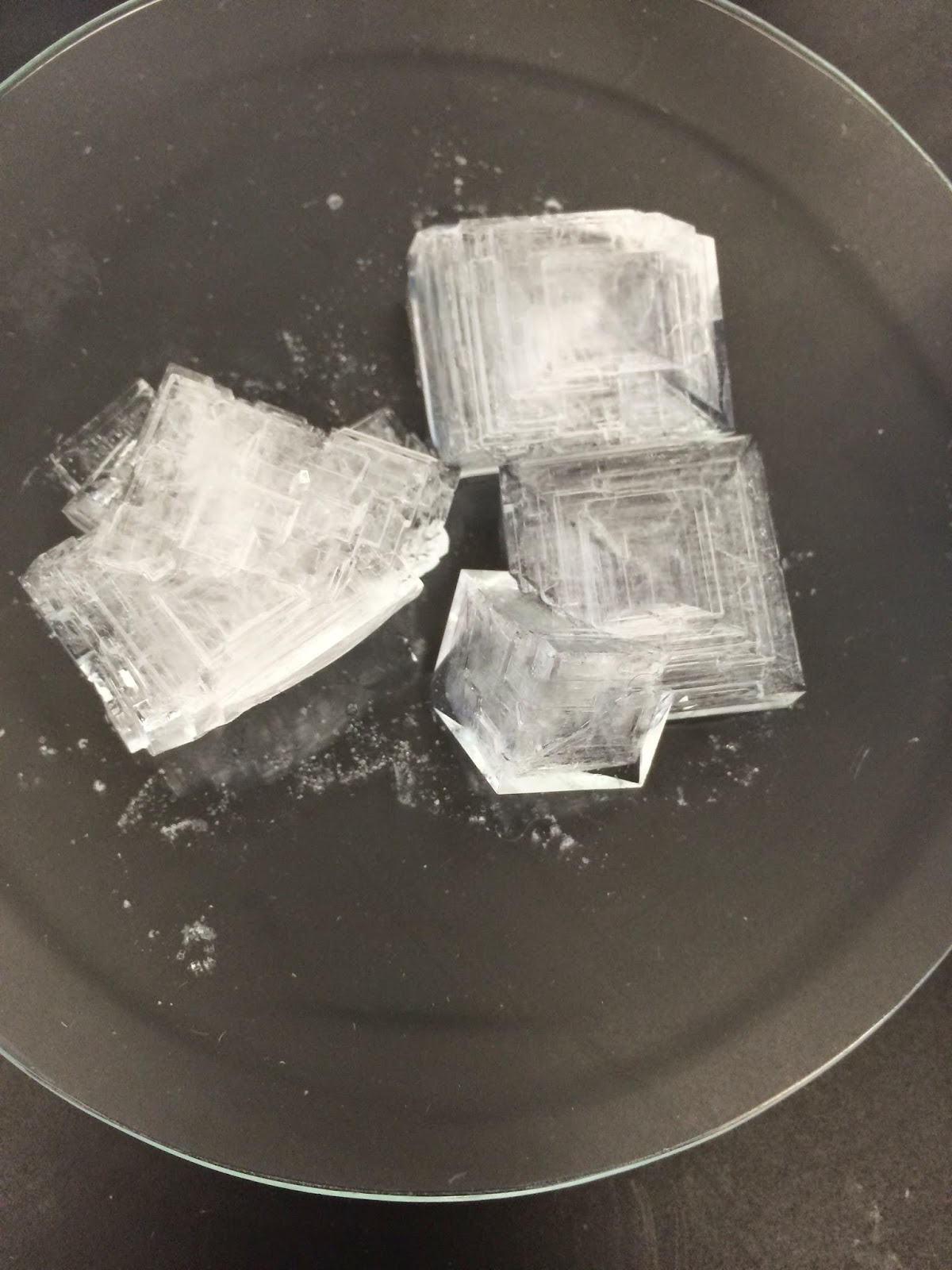
  Picture 4:  ED, RQ, and SC decided to make multiple crystals and were able to grow multiple in different jars.  Of particular interest are the two cubes that have joined together.  

    Picture 5:  ED happy with his baby crystals. One is named Jerry, the other is a John Doe.  
  That's a picture of a proud father, right there.   

Chemical #3: Chromium Alum

Unfortunately, this beautiful black crystal suffered the same fate as the cupric sulfate.  
 Picture 6:  Crystallization at the bottom of beaker.  =( 

  Picture 7:  OH and MA were able to crack some crystals from the bottom.  

 Picture 8:  Some of the larger crystals that were extracted.  


Picture 9:  My favourite crystal. You can see its shape is almost perfectly octahedron.  The math teacher in me is quite pleased at the almost perfect symmetry of this crystal.

Picture 10:  OH and MA with their chromium alum octahedron crystals.  

Picture 11:  The rest of the class' sugar and salt crystals in a contest.  

I look forward to reading their reports that will maybe offer some reasons as to why certain crystals were able to grow well and others not so well.  Their recommendations in improvements to the procedure will be especially interesting, and I'm considering passing on their observations on to the next group next year to enlarge the crystals.


Class Happenings Part 1: Best Formative Blogs of 2015

If I had to choose one blog that put together the most entertaining whilst still informing the audience, it'd had to be BL's blog.  It was thought provoking (at least for me), and I will definitely be commenting on his written piece to give my opinion of his exaggeration and bias.  His written work engaged the audience and had me talking about it.  He expanded upon what was covered in class and had me looking up some of his statements.  In essence, he has succeeded in writing in a bit of a sensationalist style.

At the same time, everyone has different writing styles and are writing not for sensationalism, but for of a intellectual style.  Just remember to always try and engage your audience, whichever tone you choose to use.


Monday, 6 April 2015

Earth's Layers, Trillions of Carats, and the Perfect Life Conditions

Earth's New Layer

The simplified layers of the Earth only have the inner and outer core, mantle and crust.  However, today, there is a layer of molten or pliable rock that is found to be quite stiff in Earth's mantle.  What's interesting is that they used diamond anvils to apply massive amounts of pressures to rocks to simulate conditions deep in the Earth to find this layer.  Read more here @ popular science.  


Raining Diamonds

Imagine a meteorite containing more diamonds than all of the deposits known on Earth just landing your country.  Apparently, that's what happened.  These diamonds are also claimed to be harder than Earth diamonds due to the immense amount of pressure and temperatures at the moment of impact which was a crater 100 km wide.  Can you please picture that for a moment?  Driving in a crater for an hour at 100km/hr.  That's how big the explosion was...35 million years ago.  Check out more from the Huffington post.


Checking out the Rings

Saturn's 6th largest moon, Enceladus, the source of Saturn's outermost ring now tops the list as most probable world to contain life.  Sean Hsu, from Boulder University in Colorado lead a team to study the rings and discovered that the silica point to WARM waters.  It's hard to imagine that something warm could exist so far out, but the small uniformity of the silicate materials serves as evidence.  Their work has been published in Nature and can be further read about here on Popular Mechanics.


Tuesday, 24 March 2015

Post March Break

Advertisements for Other Exoplanets

As Mars One whittles down to its finals to sending humans on a one way mission to Mars, NASA has already started advertising for other exoplanets outside of our solar system but seem to have habitable environments.  Here is my favourite.  Which one is yours? 


Extent of Human Broadcasts

You know, sometimes I wonder if aliens will come and visit our Earth because of the recording on Voyager 1 that is "rolling out the red carpet" by giving the directions to our Earth blindly to any extra-terrestrial life out there.  Then, I remember, even though our radio broadcasts are moving at the speed of light, our first radio broadcast in the early 1900s has only reached this far in our milky way galaxy:


There are 100 billion galaxies out there, and our radio broadcasts haven't even reached the edge of our one galaxy yet.  


4/9 Boundaries Crossed...Until Planetary Destruction

So, apparently, we're almost halfway to human destruction.  The speed with which the diversity of living beings is decreasing (biodiversity loss) and the amount of nitrogen we are taking out of atmosphere have also been passed.  It's like we're slowly checking off things to our own extinction...check...check...

Well - I'm doing my best to reduce my carbon footprint after my wife and I purchased a hybrid.  

I like Earth.  "If you like it, put a ring on it".  The closest ring I can put on Earth is:


                                                        (from reddit...of course)


We are creating minerals and identifying minerals this week.  I can't wait to see who wins the crystal growing competition!  


Sunday, 8 March 2015

Ginormous Black Hole 
A couple of weeks ago, the largest black hole with an ultraluminous quasar has been found.  You can see how many times bigger it is than anything else that we've found by looking at the graph below.  Props to the international team lead by Xue-Bing Wu of Peking University.  Check out more here!  


Creating a Different Kind of Life
A team of Cornell University researchers has successfully modeled a methane based, oxygen free life form that can metabolize and reproduce.  This points to the possibility of life on other places that are really cold with methane, like Saturn's moon Titan.   


Emotional about Space
I hope you guys get professors like this who absolutely love their job in the next few years.  This professor Tom Burns really gets emotional talking about space.  Couple that with an Inception soundtrack, and then maybe some goosebumps may rise.    

Mars and Water
Using the riverbeds of Mars mapped out by the rovers, artists have created an image of Mars when it was covered in water.  

Gravitational Lensing
Whoa, those presentations were quite impressive last week. We had tremendous discussions involving gravitational lensing; its effect has also given us a rerun of a supernova.  Check it out!


Wednesday, 25 February 2015

Exciting Stuff on Earth and in Space


Large holes of ground continue to disappear into the depths of Earth somewhere in Siberia.  There were many hypothesis behind the sudden collapse of ground - ranging from nuclear testing to the end of the world.  Check out more on iflscience!


The Mars' Rover, Curiosity, recorded a long burst of methane that lasted about 2 months.  Methane is a molecule that points to either 1)  the existence of hydrothermal systems or 2) some bacteria or alien cows farting.  It's an exciting development that may point to life on Mars.  Current life.


Curiosity, the rover, takes a selfie

Nacho Average Cheese.  The oldest piece of cheese has been found.  Using dating techniques that we will study in 2 months from now, the cheese, from 1615 BC, was discovered in clumps on mummies of Bronze Age people buried under wooden boats wrapped in cowhide.  This burial ritual created a vacuum packing effect that's better than our ziplock bag in our kitchens!  Read some more here on popscience.


I shall end off this post with a tremendous video from NASA.  NASA's Solar Dynamics Observatory released time lapse videos of extreme violet, ultraviolet, and visible light.  We get to see solar flares and prominences up close and personal:


Tuesday, 17 February 2015

Welcome, Class of 2015

Whoa, another Earth-like planet was discovered, and some NASA scientists say it has probable life!  It is 'only' about 500 ly away from us, and its orbit is in the 'habitable' zone, a similar distance as we are away from the sun!    Check out the video below for further details.


A question was asked to me the other day - how do super massive black holes come into existence? Well, one way for a black hole to be a billion times bigger than our sun, is to merge black holes, of course!  Behold, a simulation of two merging black holes.


Oh my - some research into Einstein's equation has some scientists claiming that there was no big bang and that this universe has always existed.  Their math has the universe at a finite size, and thus an infinite age.  We will see how much traction this gets, if other scientists jump on board or find some error in their assumptions, or even their math!  Read more here at phys.org.  


The big four of Jupiter's moons were on display last month.  Take a look at this spectacular footage. Make sure you don't mistake the shadows on Jupiter for moons!  Read more at one of the more popular space blogs, Bad Astronomy. 

With so many questions in class regarding dark matter, I just wanted to post this oldie from popular science that really showcases how hard our scientists are at work trying to find dark matter.


An amazing animated GIF showcasing the powers of our current telescopes shows the pillars in monkey head nebula.  It starts with the constellations we see in the night sky, and demonstrates how far back in space/time we're able to see.  It's beautiful and really a sight to take in.  

Ok - now it's your turn to blog!  Find ONE topic and start going in depth.  Good luck!